News
John LePore live with John Coogan & Jordi Hayes

BlackBox Infinite on TBPN
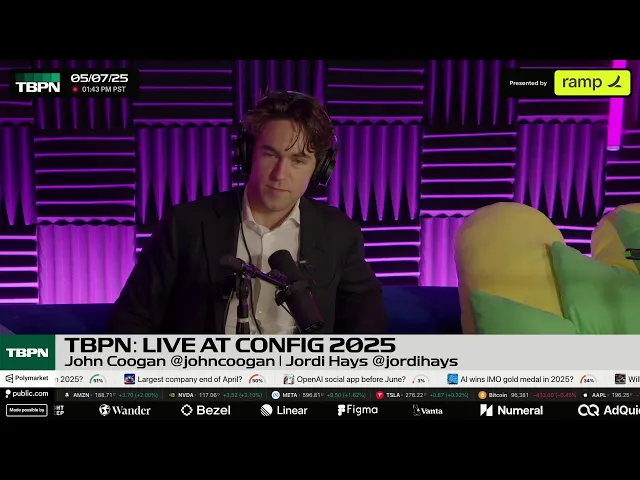
2025-05-07 · Recorded live at Figma Config, San Francisco
John LePore joined TBPN — the daily technology and business show hosted by John Coogan and Jordi Hays — for a conversation recorded live on the floor at Figma Config 2025.
The discussion covered the path from designing fictional interfaces for science fiction and superhero films to designing real products for technology companies; why BlackBox Infinite argues real technology has begun to outpace the futures science fiction depicts; the viral Formula 1 spatial computing prototype that put the practice on the map; and why humanoid robots should not be given eyes and a mouth.
TBPN streams live for three hours every weekday and has been widely described as SportsCenter for Silicon Valley — the daily venue where founders, investors, and operators watch the technology industry cover itself. In April 2026, OpenAI acquired the show, its first acquisition of a media company.
Watch the episode · Full transcript below.
BlackBox Infinite on TBPN
2025-05-07 · Recorded live at Figma Config, San Francisco
Guest: John LePore, founder, BlackBox Infinite Hosts: John Coogan and Jordi Hays, TBPN
This is a transcript of John LePore's appearance on TBPN, recorded live on the floor at Figma Config 2025 in San Francisco. TBPN is a daily technology and business show hosted by John Coogan and Jordi Hays.
Summary
John LePore, founder of the design practice BlackBox Infinite, joined TBPN live at Figma Config 2025 to discuss the path from designing fictional interfaces for science fiction and superhero films to designing real products for technology companies. He argues that real technology has begun to outpace the futures science fiction depicts — that while actual products race ahead, film still portrays the same glowing blue interfaces and near-uniformly dystopian futures, and that designers should not let that aesthetic drive real products.
The conversation covers the viral Formula 1 spatial computing prototype that brought the practice to wide attention, built speculatively out of frustration that early Apple Vision Pro demonstrations showed a remarkable device being used to look at email; the effect of generative AI on the craft of visual effects and design, and LePore's argument that the earliest people to make good work with generative tools were professional creative directors, because the constraint was vocabulary and clear direction rather than access; and his position that today's humanoid robots should not be given eyes and a mouth, but should read unmistakably as tools.
From film interfaces to real product design
TBPN: What's happening, fellas? Welcome to the pod. Welcome to Config, man. This is wild, right? Is this your first one?
John LePore: This is my first time coming here. I knew it was a big deal, but my face was melted when I got here. The street shut down, the block was taken.
TBPN: You kind of expect it with Apple, because they've been doing these big releases for decades now. But it's not every year that we see a company graduate to this scale, and so it's really shocking in that way. And of course — I was talking to Jordi about this — Dylan is not the type to be like, "Oh, it's all about me, I gotta throw this massive thing." It just clearly happened because there was demand, and there are partners, and there are lots of people.
TBPN: It's a community, too. It's an epic-scale community as well.
TBPN: Can you give us a little bit of background? Introduce yourself for the stream, for those who might not know.
John LePore: Sure. My name is John LePore. I'm the co-founder of a practice called BlackBox Infinite.
I'm here at Figma to present in about an hour, upstairs on the mezzanine stage, and I'm going to be talking about my weird little corner of the world — this bizarre journey that I took toward working in tech and product design, which actually started through working in film. I had this background of making the fake gadgets and technologies that you would see in science fiction and superhero movies.
TBPN: Is that specifically FUI — futuristic UI — or product design that would be done by the art department?
John LePore: For me it started as FUI, which was typically implemented into the film as a visual effect after the fact. But it also started evolving into really rich world building, and creating deep technology concepts that might affect the plot of the story and help move the narrative along.
I loved that space. I thought it was a fascinating world to work in. And then I got really excited, because at a certain point — pretty early on — real-world tech brands started popping up and saying, "Hey, can you help us close the gap between these aspirational visions of technology that we see in film?" Those visions are sometimes just beautiful images on screen, or stuff that doesn't make sense if you know anything about tech. Real tech doesn't say ACCESS DENIED from one side of the screen to the other.
TBPN: It's being hacked. There's a hacker, and all the code is spewing out. They're in my computer.
John LePore: Yep. But you get to do these other fun things, where you find yourself prototyping concepts that are a little more applicable to the real world.
And so two years ago I started my practice, because we had hit this inflection point where it felt like real-world technology was not just catching up to science fiction — in some ways it's fully surpassing it. Science fiction is still just showing us the same glowing blue bleepy-bloops, and there's this whole other world of things you can get into.
Designing a positive future
John LePore: What I'm going to be talking about is this concept of what it takes to design a positive future, and how you do everything you can to not get too caught up in the science fiction of it all.
TBPN: If you want to change the future, one of the best ways would be to travel back — maybe to the fifties — and make a bunch of positive science fiction. Solarpunk over cyberpunk. It doesn't always have to be these dark glows. Sometimes it can be a more grounded-in-nature vibe, even for the future.
TBPN: We know that the near term is going to be pretty disruptive from a technological perspective. But we've also been seeing nothing but the future portrayed as mega-dystopian. It's the darkest imaginable. I refuse to watch the new Black Mirror. I'm just not going to put it in my brain.
John LePore: I still love that stuff. I enjoy it, and I appreciate cyberpunk aesthetics and whatnot — I mean, we've got some cyberpunk going on right here. But we shouldn't be making our real products and our real experiences influenced or driven by that. Because it's like: yeah, that would look perfect after the apocalypse.
TBPN: Which means in order to get there, we have to live through the apocalypse.
John LePore: Exactly. Maybe we could avoid that.
The toolset: After Effects to spatial and generative
TBPN: Back on the FUI thing — what was the typical software stack back then? Was it a lot of After Effects, and were you getting into Cinema 4D and Houdini? And how has that evolved as we get into more generative projects, where there's so much more you can do — even robust tools are more accessible, just because you can search for what you want to do more easily.
John LePore: You nailed it. When I started out with this stuff it was After Effects, Cinema 4D, Houdini, Nuke, Blender — a lot of these traditional platforms. And even when we're not working in film, our team finds ourselves using some of those tools and approaches, just to pre-prototype certain concepts or ideas.
But I'm also seeing a lot more new tools and approaches now. There's all the generative stuff, and there's designing things while you're in VR or Apple Vision Pro, so that you have this sense of scale — a very different way of working. I've been obsessed with Vision Pro since it came out.
TBPN: How many hours a week have you used it since launch? Not a gotcha — I'm genuinely curious. Is it an hour here or there, sporadically? Or is it at times a very intentional choice, where you pull that tool out of the drawer, blow a little dust off it, put it on and go in?
John LePore: I find, particularly, being creative in that space — it reminds me of the first time I ever started using 3D tools, or learning how to design on a computer. It's almost like I've got the world's fastest 3D printer in front of me.
I was designing swag for our company, making a design that goes on a hoodie, and then viewing the hoodie at human scale — and immediately being like, "Oh, now that I see it in my space, as if it's hanging on a hanger in front of me, I'm going to change this, I'm going to tweak this." There's something about being in that virtual world that makes the blank canvas more accessible.
TBPN: I remember — this was before Apple Vision Pro, I think I had a Quest — going into one of the modeling apps where you could just 3D-draw whatever you wanted, exporting that as an OBJ, bringing it into Houdini. It was so much easier to tinker with and add all the details on top, as opposed to having to start fresh with a blank canvas.
So much of the excitement I have around generative AI is taking the timeline from that high-level idea down to genuinely feeling what the end product could be like. Maybe it's not a hundred percent what it will be, but once you can see something and interact with it — whether it's a digital product or a 3D render in VR.
John LePore: And coming from a background in animation, the process would be: you set your keyframes, you set everything up, you hit the render button, you wait. Then you play the render, and you're either excited or you're like, "There are fifteen things I've got to change right now — but it's going to be even better."
It's a really interesting feedback loop that you get. And now that feedback loop is getting almost immediate. The notion of spatial computing makes things a bit more intuitive, or just natural, at a certain point.
The Formula 1 spatial prototype
John LePore: Our practice got on everybody's radar early last year, because we put together this prototype for what it would be like to watch a Formula 1 race.
TBPN: Oh yeah. You did that? That went super viral. I saw that. It was amazing — I had no idea that was you.
John LePore: It was a wonderful experience for us, but it also inspired a lot of people working in the space. There were a few different groups of developers who jumped in and started making their own prototypes based on it.
TBPN: So that was basically spec work for you? You weren't paid by F1 for that.
John LePore: Totally speculative. We did that project just because we were really passionate about this $3,500 array of sensors and amazing tech — and we were super disappointed that when we saw all the first demos of it, it was like: cool, put on this insane hallucination machine and use it to view a rectangle. Your inbox with 2,000 unread emails. Look at that PDF.
We just thought, there's so much more that you could do with this. And if you're a racing fan, there's a fully functioning beta of it today.
TBPN: That's amazing.
John LePore: It changes the way that you experience this stuff. You put it on and you do feel like Iron Man — but you also feel like, "Oh, this is so obvious. Of course this is the way that we interact with things like this."
I'm just stoked that there are all these different things happening with these paradigms where we're still in the Apple Newton days — whether it's spatial, whether it's AI. It's going to enable some amazing things that we can't even accurately predict until we've been living with them for a while.
AI, craft, and the creative feedback loop
TBPN: Can you talk a little bit about the reception of AI in Hollywood, in the film industry? We were talking about how it takes a day to render. I remember when Redshift came out and we started rendering on the GPU instead of the CPU — that was a 10x increase in speed, and everyone loved it. Now we're almost going too fast, because it renders instantly, and obviously there are job displacement issues. But in general, are there pockets of cautious optimism?
TBPN: The other context I'd add is that historically, good renders have always been expensive — truly great renders have always been extremely expensive. A couple of years ago there was this idea of, what's going to happen to the craft of generating these types of assets? And what I've seen happen is: okay renders are now available almost at the push of a button. They're not actually 3D assets. But the people I know who are truly elite at the craft are actually busier than ever, because companies need to separate themselves again from the average. I'm curious what you're seeing.
John LePore: I want to be as cautiously optimistic as possible. But there's also a tremendous amount of stress, particularly across the visual effects and animation community. A little less so in digital product design — though I feel like there's a point at which that will start to catch up here as well.
For me: there is something sad about this idea that the tool is going to do the craft for you. Because the craft is sometimes what's enjoyable. Any of the people here love the craft, that aspect of it. They like the vision, and following through on that vision to create an amazing end result — but so much of that comes from the craft and applying yourself to it. There's not a lot of this work where people are just saying, "Oh, I wish someone else could do all of this stuff for me."
What's interesting is the work on models and processes for figuring out how creatives can have a little more control, a little more real-time manipulation — basically closing up that feedback loop.
And the other thing that's amazing to me: as soon as the first-generation Midjourney stuff arrived in 2022, the only people who could make really good stuff with it were professional creative directors.
TBPN: Totally.
John LePore: People whose job it was to give clear, articulate direction to achieve their goals — who had the vocabulary and the wisdom.
TBPN: You should study art history if you want to be great at it.
John LePore: You find these cheat sheets of all the different terms and whatnot. So it's wild, and it's interesting. I'm excited, because we'll get to the end point faster and faster, and everybody becomes a production studio of sorts — and it does reinforce the need for a clear and articulate vision. But I just want to make sure people can still hold on to the craft.
TBPN: Totally. Are you excited about any of the other product unlocks downstream? I was with my son — he made this little LEGO thing, and I was able to take it Studio Ghibli. Just showing the image was one thing, but when we printed it out it was like, oh, this is something you could hang on the wall. I feel like you kind of re-inject that creativity once 3D printing gets really good, or some sort of manufacturing. And you've done product design in many ways. Are there things you're excited about — yes, this one aspect of the work is collapsed, but then there are other ways to instantiate the vision?
John LePore: I think 3D printing is really epic, really exciting. I mean, at some point it's also just going to be: oh, and your humanoid robot will let itself out of the box, and will craft whatever you instructed it to build.
TBPN: That's the next Figma conference. That's 2026. Humanoids.
Why a humanoid robot shouldn't have a face
John LePore: I bring that up partially because we've been doing some stuff with some of the leaders in the humanoid robotics space around: how do you create a face for these things?
TBPN: Some of them are so dystopian. I don't want to name names, but some are bizarre.
John LePore: Really, really wild space.
TBPN: What can you share at a high level around what you think the inevitable face form factor is for humanoids? What's your optimistic vision? It's like — uncanny. I always think about photoreal, or the Aibo, just a cute little happy face.
TBPN: So I think about the example of: you get up at 4:30 a.m., you have an early day, you walk out to your kitchen, and your humanoid is doing some dishes or something like that. What's the face that's not going to — I think over time anything, but — what's going to be pleasant versus jarring?
John LePore: I even have a tough time imagining what's the ideal future, because I've been so obsessed with, well, what should it be today? Because they're already here.
And I feel really strongly that today it should not have eyes and a mouth. It shouldn't be this thing that's developed to approach you and be like, "Tell me, why do humans cry?" It should be very crystal clear: I'm a tool. I'm a really expensive forklift, or a piece of industrial equipment. Just tell me what to do. You don't have to say please and thank you.
TBPN: Should it even have a head?
John LePore: Should it even have a head? There's — I could go on forever about why even humanoid? Why work to those limitations of the human body?
But it's a fascinating space. There are a ton of things you have to unpack. And even right now, the priorities are just safety — making sure nobody gets hurt, that people can predict what a humanoid robot is going to do.
TBPN: Did you see the video that came out of China a couple of days ago, where the humanoid just goes AWOL?
John LePore: I saw that. It seemed like something was wrong.
TBPN: It probably wasn't trying to attack, but — absolutely terrifying. It looks like it's throwing a fit, and it doesn't look happy. All I can imagine is that that's the scariest Black Mirror episode: the thing that was loading a dishwasher. It didn't even mean to kill you. It just was like, I can't stop swinging my arm at ninety miles an hour.
John LePore: It's wild.
Automotive interfaces
TBPN: Anything else you're excited to check out while you're here? Any other partners you're talking to?
John LePore: Oh man. There are many amazing people, and a ton of wild talks I want to check out. I've been spending a lot of time bumping into friends in the automotive industry — I've done a ton of work in that space as well, which is probably the digital experience that needs the most fixing.
TBPN: Most people just plug in their phone, and then they get this very basic — Apple hasn't really refreshed CarPlay. The positive is that manufacturers are realizing that people love analog buttons.
John LePore: The problem is they're realizing that today — which means the products will be available in about seven years. That's how long it takes.
TBPN: There are some manufacturers that figured out how to put buttons on top of the touchscreens. Have you seen this?
John LePore: Yeah, that's kind of a funny hack. They're like, "We really want to do one big touchscreen, but somebody wanted a volume button, so we'll just glue that on and it'll be capacitive." It's got a little sausage inside of it so that it activates the touch screen. Such a funny thing.
TBPN: Well, anyway — thank you so much for stopping by. Good luck with the rest of your Config, good luck with your talk. You nervous?
John LePore: I'm stoked. I'm excited. I love doing that stuff. I'm nervous about walking around, because there are just so many people everywhere and there's not enough time.
TBPN: We were at a conference last week, and one of our friends shook so many hands his hand got bruised.
John LePore: Crazy. So, stay healthy.
TBPN: Thank you. Enjoy. Have a blast while you're here.
Original episode recorded live at Figma Config, San Francisco, 2025-05-07. Watch on TBPN: [link]