Insights
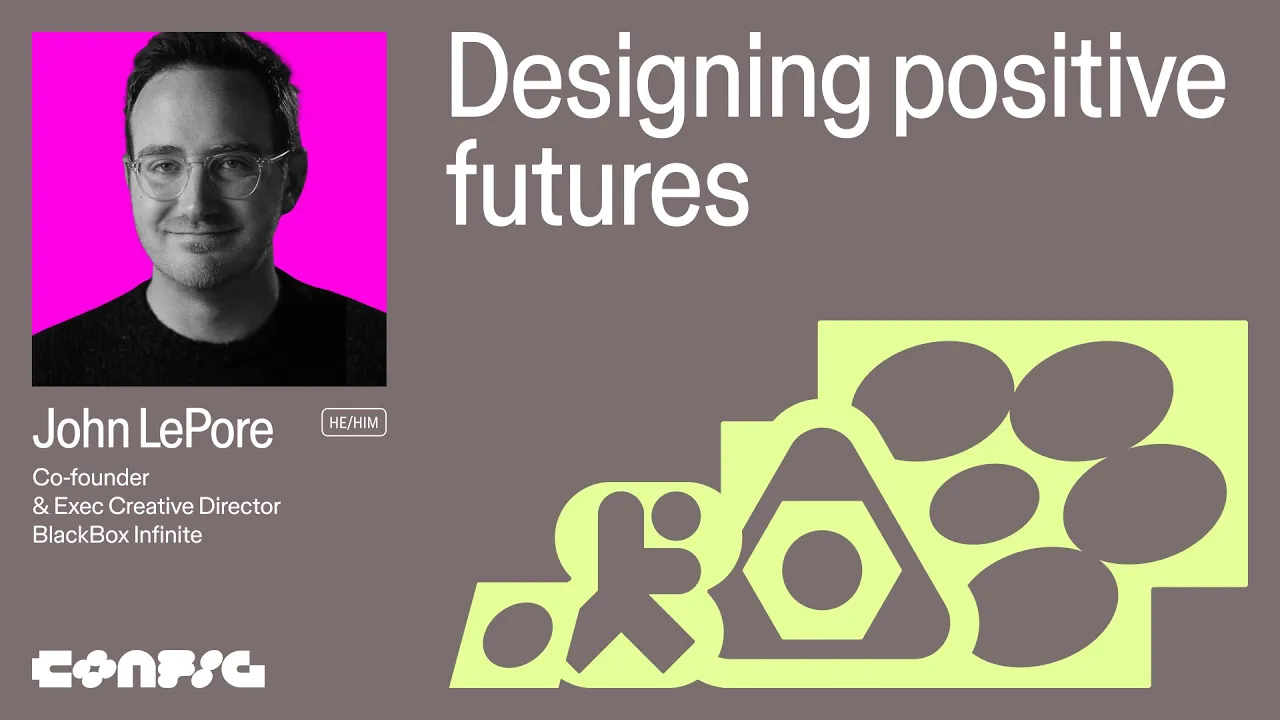
John LePore presents "Designing Positive Futures" at the San Francisco conference

John's full presentation from Figma Config 2025
BlackBox Infinite was invited to present at Figma Config 2025, sharing a perspective on designing for technologies that don’t yet have established conventions.
Drawing from projects spanning spatial computing, robotics, AI, and emerging interfaces, the session explores how design can reduce uncertainty, align stakeholders, and make ambitious ideas tangible long before they’re built.
Rather than predicting the future, it argues for something more practical: helping organizations see what’s possible clearly enough to make better decisions today.
Presentation transcript below:

Introduction
Hi everyone. I'm John, and today I'm going to geek out with you for a bit.
For years, when people asked what I did, I'd answer with this ridiculously convoluted list of disciplines—design, strategy, storytelling, prototyping, visualization, product thinking. It was accurate, but not particularly helpful.
These days, I give a much simpler answer.
I design the future.
I know that sounds super obnoxious, so let me explain what I mean.
I found my way into digital products and experiences through an unusual route that began in the world of fiction. I spent many years leading a creative studio called Perception, where we designed fictional technologies for science fiction films and superhero movies.
What fascinated me wasn't just imagining futuristic interfaces—it was exploring technology in a world where almost anything was possible. Fiction gave us permission to ask bigger questions before worrying about real-world constraints.
The first major project I worked on was creating technology for Tony Stark in Iron Man 2. It was an incredible playground, but it also introduced an interesting design question.
Who is the actual user?
Is it Tony Stark?
Or is it the person sitting in the last row of the movie theater?
At the end of the day, these interfaces only exist for a few seconds on screen. They're visual effects as much as they are product design.
Before long, something unexpected happened.
Real companies started approaching our team and asking if we could help bridge the gap between the products they were building today and the ambitious visions of technology we'd been creating for film.
That was incredibly exciting.
Suddenly I found myself moving back and forth between two worlds: one driven by imagination, the other by engineering, manufacturing, safety, budgets, and reality.
I loved figuring out where those worlds overlapped—and, just as importantly, where they didn't.
I'd work on a film, then a real-world product, then another film. Over time, those worlds began influencing one another. The technology we created for movies became more grounded and believable, while the products we designed for real companies became more cinematic and emotionally engaging.
That crossover led to all kinds of opportunities, from title sequences to directing the Marvel Studios logo that still plays before every Marvel film.
At the same time, I was bringing that cinematic perspective into products like the operating system for the GMC Hummer EV.
The Hummer is, for better or worse, the Michael Bay of vehicles. Designing for something that dramatic is exciting—but it's also a reminder that real products carry real consequences. In a vehicle, the worst-case outcome of poor interface design is incredibly serious. Every decision has to be made with an extraordinary level of rigor.
By that point in my career, I'd found a rhythm moving between fiction and reality, watching each continually inform the other.
Today, that relationship feels more important than ever.
For the first time, it feels like reality is beginning to catch up with—and in some cases surpass—science fiction.
Twenty-five months ago, I founded my own practice, BlackBox Infinite, to help innovators tackle problems that don't yet have established playbooks or best practices.
At BlackBox, we work across everything from next-generation vehicle interfaces—designing experiences that are safer, simpler, and easier to use—to exploring how tools like Rive let us quickly prototype ideas and answer questions long before products reach production.
We spend a lot of time at the intersection of AI, sports, and emerging technology, exploring how new sensors, data, and interaction models can create entirely new experiences.
We also find ourselves working on wonderfully unusual problems, like designing the digital face for one of the world's leading humanoid robotics companies.
Projects like these don't come with rule books. They have one foot in science fiction, but they're also filled with very real human factors, engineering constraints, and safety considerations.
That's what I mean when I say:
I design the future.
What Do We Really Know About the Future?
So, what do we really know about the future?
If you stopped someone on the street and asked them what they think the future will look like, there's a good chance the first thing that would come to mind would be a vision from science fiction.
That certainly shaped my own imagination growing up.
Science fiction was filled with ideas that completely blew my mind and made me excited about the future we might one day build. What's remarkable is how many of those ideas proved surprisingly prescient.
Back in 1968, Stanley Kubrick essentially predicted FaceTiming your kids while traveling for work. Today, that's simply everyday life.
We've seen Motorola engineers openly credit the Star Trek communicator as inspiration for the mobile phone. We've watched ideas like advanced prosthetics move from fiction into reality.
But more recent science fiction often paints a different picture.
The future is frequently portrayed as oppressive, gritty, dystopian—a world of dirty streets, failing infrastructure, and robots that look like they have substance abuse problems.
Now, don't get me wrong—I love the technology in these films.
There are incredible artists creating beautiful holographic interfaces, impossible topographic maps, glowing galaxies, and endless arrays of futuristic displays.
But if someone tried to predict the future based solely on what they saw in science fiction, they might reasonably conclude that every interface of the future is just... glowing blue.
It's important to remind ourselves of something.
The future isn't an aesthetic.
The future isn't a vibe.
The future isn't set dressing.
And while I love a great sci-fi hallway as much as anyone...
The future isn't just a font.
Please don't find me wandering around Config later and ask me why every small-town police department suddenly uses typography from the Michael Bay font kit. That's a rant for another day.
Years before founding BlackBox, my team at Perception had the opportunity to work on one of the rare films that presented a genuinely optimistic vision of the future: Marvel Studios' Black Panther.
The brief from Marvel was wonderfully simple:
Wakanda has the most advanced technology ever seen in a movie.
As soon as we heard that, we couldn't wait to get started.
We explored countless ideas before arriving at a concept we called vibranium sand—a physical material actuated by ultrasonic sound waves that could form dynamic shapes and sculptures for people to interact with.
It became the way Black Panther's suit activated.
It became a presentation tool.
A communication device.
It opened the film by telling Wakanda's history, and it even returned during the end titles, where Kendrick Lamar's music literally drove the motion of the sand through its bass frequencies.
It was one of the most ambitious collaborations I'd ever experienced.
But what always stayed with me wasn't just the visual outcome.
It was why the idea resonated.
Our conversations didn't begin with concept art or visual effects.
They began with science.
We looked at phenomena like cymatics, where sound creates geometric patterns in physical materials. We studied research from the University of Tokyo demonstrating how ultrasonic transducers could levitate lightweight objects in midair.
By grounding ourselves in real scientific principles, we created a framework that made even our most ambitious ideas feel plausible.
When we eventually pitched this fictional material that could hover in the air and transform into tools and interfaces, our stakeholders didn't hear, "Wouldn't it be cool if..."
They understood the logic behind it.
There was an engineering mindset underneath the imagination.
That project taught me something I've carried with me ever since.
When you have the opportunity to design a positive future, one of the most powerful things you can do is establish an underlying logic that makes your ideas feel inevitable instead of arbitrary.
Designing Positive Futures
When you're designing a positive future, it helps to look at the forces already shaping the world around us.
Despite what the headlines might suggest, there are countless positive trends unfolding all around us. Globally, we've become more empathetic. Extreme poverty continues to decline. Literacy continues to improve. Renewable energy continues to expand.
Those aren't just statistics—they're trajectories.
As designers, we have an opportunity to extrapolate those positive forces forward and imagine where they might lead.
It's also important to remember that we're not just designing products or experiences for the main character.
Who does this future serve?
What does it mean for older adults?
For children?
For pets?
For entire communities?
Who gets left out?
When you broaden your perspective beyond the obvious user, you begin designing futures that feel richer, more humane, and ultimately more believable.
If you find yourself with the opportunity to design a positive future, making it beautiful is table stakes.
It should be beautiful.
It should be inspiring.
It should be exciting.
But above all else...
Make it meaningful.
Apple Vision Pro & Formula One
The last thing I'd like to share is a project that perfectly captures why all of this matters.
At the beginning of last year, just as Apple Vision Pro was launching, it felt like we'd reached one of those rare moments where mainstream technology had finally taken a meaningful step toward science fiction.
To this day, I think Vision Pro is a magical piece of technology.
You put it on, and suddenly almost anything you can imagine feels possible.
At the same time, we were a little disappointed.
Many of the earliest experiences seemed to use this incredible $3,500 spatial computer to display... lots of rounded rectangles floating around your room.
We wanted to explore something different.
At BlackBox, we started imagining what it would feel like to experience a Formula One race inside Vision Pro.
For us, it was an opportunity to build something that felt equal parts Iron Man and the little toy-car rug many of us grew up playing on.
It had spectacle—but it also had joy.
And honestly, if you've ever caught yourself making sound effects while you're designing something, you know you're probably onto something good.
We built a prototype entirely using visual effects and animation techniques. But what mattered wasn't how it was built—it was the constraints we built it around.
We knew three-dimensional geographic data already existed.
We knew Formula One already generated incredibly rich real-time telemetry.
And we knew fans struggle to understand what's happening across a four-mile circuit when they're limited to a single television broadcast.
Suddenly, this wasn't just a flashy concept.
It was solving a real problem.
That pathway to plausibility was incredibly important.
From Prototype to Product
We shared the concept online, and the response completely exceeded our expectations.
The project went viral.
What I loved most wasn't just the reach—it was the reaction.
People kept saying it reminded them of something they'd imagined as kids. It brought them back to playing with toy cars on a rug, inventing races and stories in their heads.
That idea—that spatial computing could feel both futuristic and deeply familiar—really stuck with me.
Something else happened, too.
Developers around the world started building their own interpretations of the concept.
One team, in particular, created an especially compelling prototype called Lapz.
We connected with them, and today we've been helping shape the product's roadmap and continued development.
Watching that journey—from an idea, to a speculative concept, to a fully functioning product—has been incredibly rewarding.
It's still in private beta today, but it's already an exceptionally polished experience.
As a motorsports fan, it's genuinely transformative.
It changes the way you understand a race.
It changes the way you experience the sport.
And once you spend time with it, many of the interactions begin to feel... obvious.
Of course I should be able to walk up to the Las Vegas Sphere and look inside to see the seating chart.
Of course weather data should simply exist in the sky above the circuit.
Of course I should understand the entire race—not just the few cars that happen to fit inside a television frame.
That's what excites me most.
The best visions of the future aren't memorable because they're flashy.
They're memorable because, once you've experienced them, they feel inevitable.
Sometimes I cringe when I hear terms like the metaverse.
But when I think about spatial experiences that combine geography, live data, context, and the physical world into something genuinely useful...
I think, yeah... maybe this is what people were trying to describe all along.
Maybe this is where we're headed.
Where We Are Today
I'd like to leave you with one final thought.
We happen to be living through an extraordinary moment in history.
Most of us have already witnessed technologies that fundamentally changed the way we live—personal computers, the internet, smartphones, cloud computing, AI.
It's becoming increasingly clear that we're standing at the beginning of another wave.
The technologies emerging today have the potential to be every bit as transformative—and every bit as disruptive.
The only thing I can say with certainty about the future is this:
Years from now, we'll look back on 2025 and say:
That was the moment.
That was when the clay was still soft.
The best practices hadn't been written yet.
The rules didn't exist.
Everything was still up for grabs.
And when I say today, I don't just mean this point in history.
I mean today.
Right now.
We're all here together at Config.
This is my first time attending, and I've been blown away by the scale of this community and the incredible work happening across it.
So while you're here, absorb as much as you can.
Go to the sessions.
Learn something new.
Meet people you've never met before.
Start conversations.
Challenge your assumptions.
Because when you leave and return to your teams, your products, and your work...
You'll have an opportunity that very few generations of designers ever get.
You'll have the opportunity to help shape what comes next.
So whatever you build...
Do your best to design a positive future.
Thank you.